
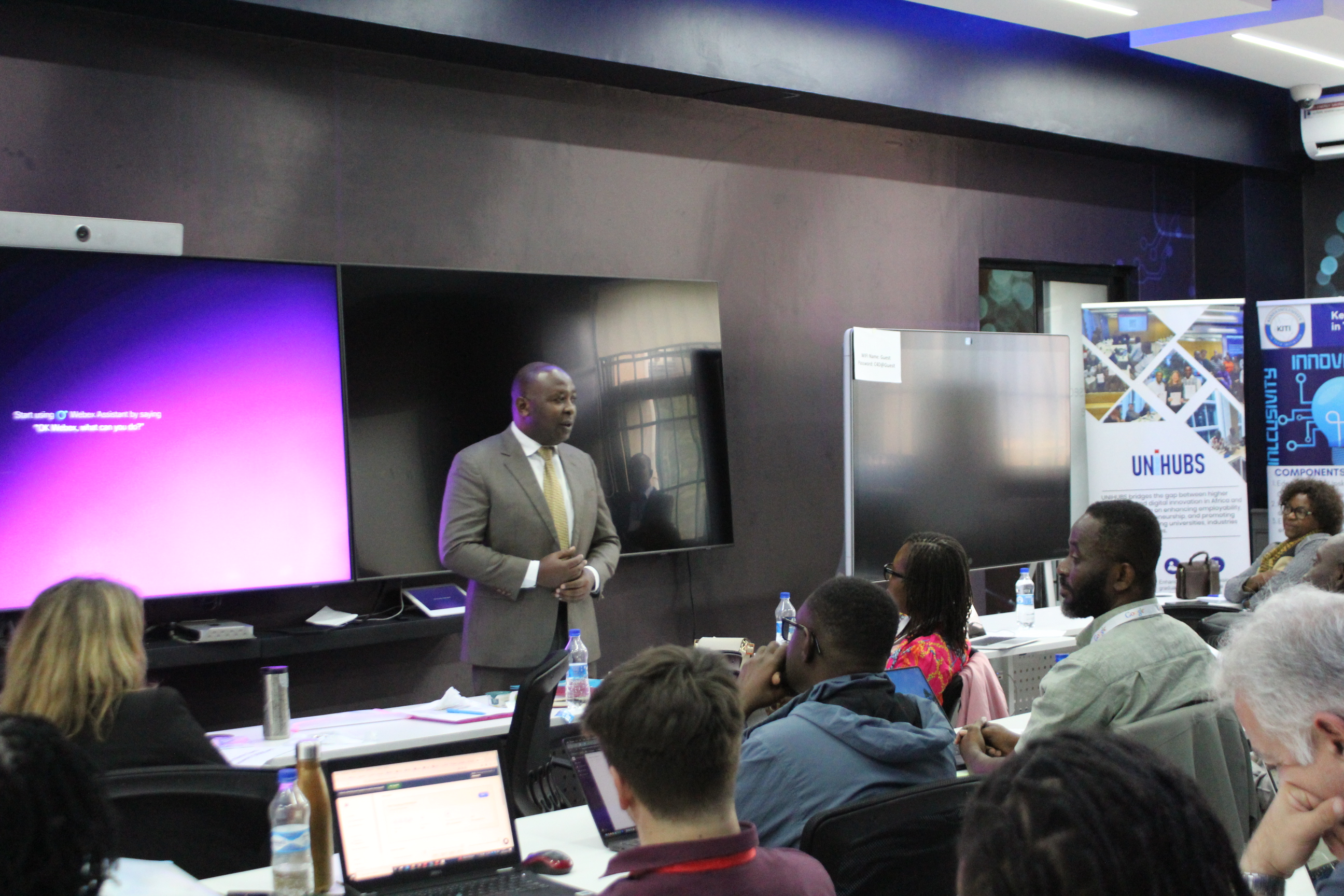
Universities are increasingly being challenged to prepare graduates for the demands of the digital economy. Through the Erasmus+ UNIHUBS project, educators and innovation practitioners from Africa and Europe gathered at the University of Nairobi to explore new ways of integrating digital innovation and entrepreneurship into university education.
From March 2–6, 2026, the Faculty of Science and Technology hosted the UNIHUBS International Training Activity and 4th Partners’ Meeting, bringing together representatives from partner universities, Digital Innovation Hubs (DIHs), and partner organizations from Africa and Europe. The event marked an important stage in the Erasmus+ UNIHUBS project as partners moved from framework design to practical implementation. At the University of Nairobi, the UNIHUBS project is anchored in the Faculty of Science and Technology and implemented by C4DLab, the university’s innovation and incubation hub.
Opening the training on behalf of the Deputy Vice-Chancellor for Research, Innovation and Enterprise, Prof. Leonidah Kerubo, the Director of Innovation and Intellectual Property Management, Prof. Maina Wagacha, emphasized the need for universities to ensure that research leads to tangible impact. “We must move from research for its own sake to research that leads to innovation and commercialization,” he said. Prof. Wagacha noted that stronger partnerships between universities and industry are essential if research outputs are to translate into technologies, businesses, and solutions that benefit society.
The Dean of the Faculty of Science and Technology, Prof. Francis Nyongesa, highlighted the importance of changing how universities approach research and teaching in the digital age. “Scientists are very good at doing research and leaving it on the shelf,” he said. “What we need is to ensure that research produces solutions that benefit society.” He also encouraged educators to adapt their teaching approaches as digital technologies continue to reshape how students learn, collaborate, and innovate.
The training programme focused on the pilot implementation of learning tools and collaboration models developed through the project. Participants engaged in a series of practical sessions designed to strengthen cooperation between universities and Digital Innovation Hubs. Key activities during the week included: Collaborative teaching simulations exploring how innovation and entrepreneurship training can be integrated into university curricula, Action-learning sessions focused on strengthening partnerships between universities, innovation hubs, and industry. Testing of the UNIHUBS online learning platform, allowing participants to evaluate user experience and provide feedback for improvement, and Strategic discussions among project partners during the 4th Partners’ Meeting to align implementation plans and next steps. These sessions emphasized practical learning, shared experiences, and collaboration among institutions working at the intersection of higher education and digital innovation.
Hosting the international training reflects the growing role of the Faculty of Science and Technology in advancing innovation, digital skills development, and research translation at the University of Nairobi. The faculty has increasingly positioned itself as a hub for initiatives that link academic research with technology development and entrepreneurship. Working closely with C4DLab, the faculty supports programmes that encourage students and researchers to transform ideas into real-world solutions through innovation and collaboration with industry.
As the project moves forward, the partnerships and tools developed through UNIHUBS are expected to help universities more effectively support innovation, strengthen engagement with industry, and prepare graduates to contribute to rapidly evolving digital economies.
About UNIHUBS:
UNIHUBS is a collaborative initiative connecting Higher Education Institutions (HEIs) in Kenya, Ghana, Tanzania, and Europe with local digital innovation ecosystems to modernize curricula and boost graduate employability. Aligned with the EU-AU Innovation Agenda, the project empowers African universities to lead in digital entrepreneurship and workforce development by bridging the gap between academia and the evolving labor market. Through research-driven insights, targeted educator training, and the co-creation of experiential learning materials - including an international online course- UNIHUBS equips business and technology students with critical, real-world skills. By rigorously pilot-testing these interventions and focusing on long-term sustainability, the project builds a globally connected education ecosystem that drives sustainable, mutual growth across both continents.
Project Partners: The 12-member consortium features:
- Europe: Erasmus University Rotterdam (Coordinator), University of Macedonia, and Stimmuli for Social Change.
- Africa: University of Nairobi and Kibabii University (Kenya); Kumasi Technical University, KNUST, and Hapa Space (Ghana); alongside COSTECH, Iringa University, Buni Hub, and Mbeya University (Tanzania).
- Log in to post comments